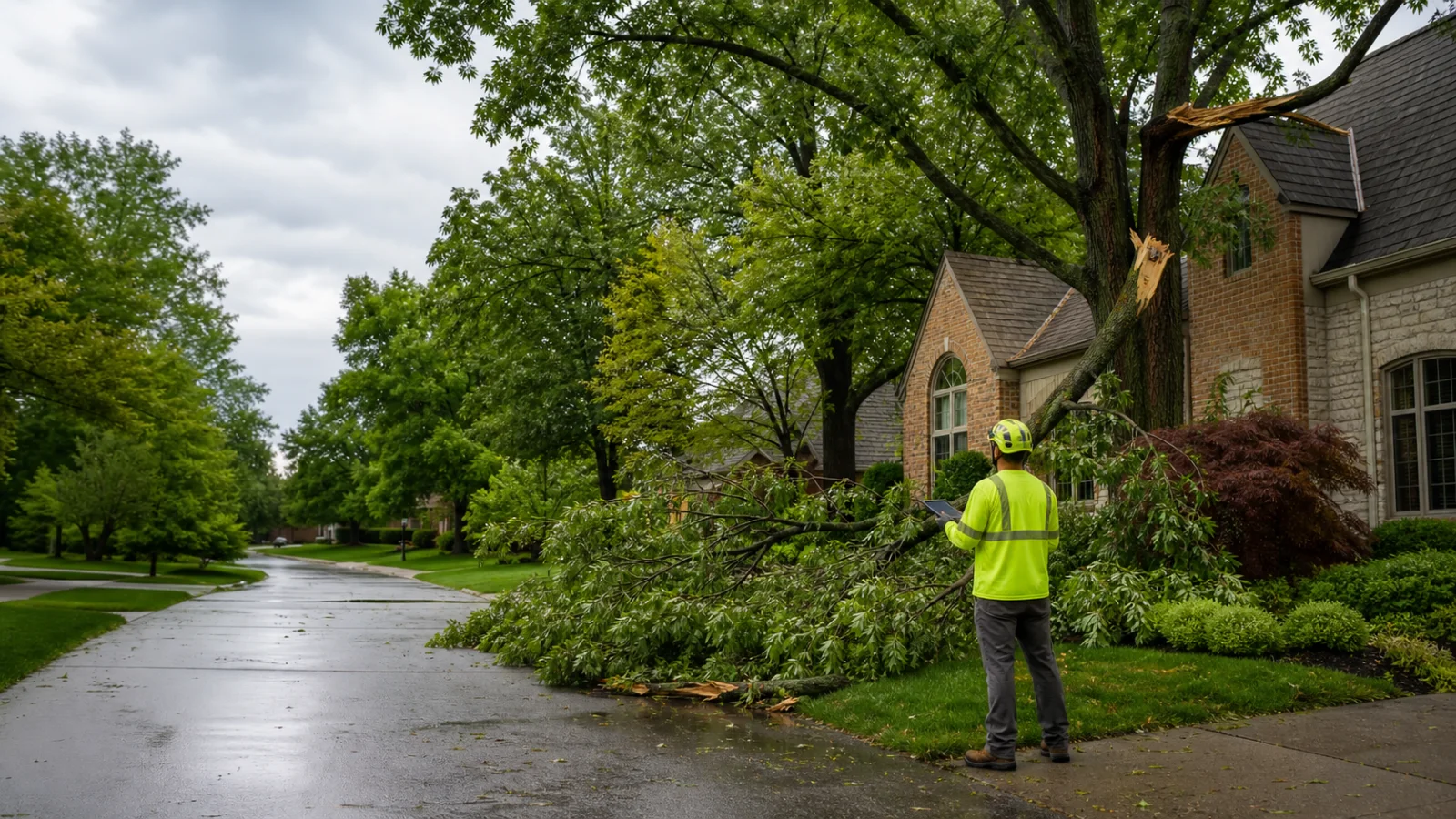
This is a facts question, not a tree-service verdict
A tree crew can identify where the trunk and root plate appear to originate and can document condition. It cannot decide insurance coverage, negligence, boundary ownership, or legal responsibility.
Do not authorize removal of disputed evidence beyond what safety requires without speaking to the relevant insurer or advisor. Photograph the tree, stump, property line indicators, damage, and surrounding conditions.
Separate private, public, and utility issues
A tree in a public right-of-way may be handled differently from a private-yard tree. Carmel asks residents to use Carmel 311 for dying, damaged, or hazardous trees in the public right-of-way.
When a line is involved, stay away and contact the utility. Tree crews should not be used as a substitute for utility clearance around energized conductors.
Insurance comes early
Notify your insurer promptly when a home, detached structure, vehicle, or major personal property is damaged. Ask what documentation is needed and whether temporary stabilization can proceed before an adjuster sees the site.
Keep written scopes and receipts for emergency access, temporary protection, tree removal, hauling, structural work, and later restoration. Those may be treated as separate work categories.
Get specific advice for disputes
Boundary, notice, and negligence questions depend on evidence and Indiana law. This article is general information, not legal advice. A local attorney can evaluate a dispute; the insurer can interpret the policy.
The practical priority remains the same: keep people out of danger, preserve documentation, and avoid making the damage worse.
Sources and further reading
Rules, recommendations, and conditions can change. Confirm current site-specific requirements before work.